Basic theory
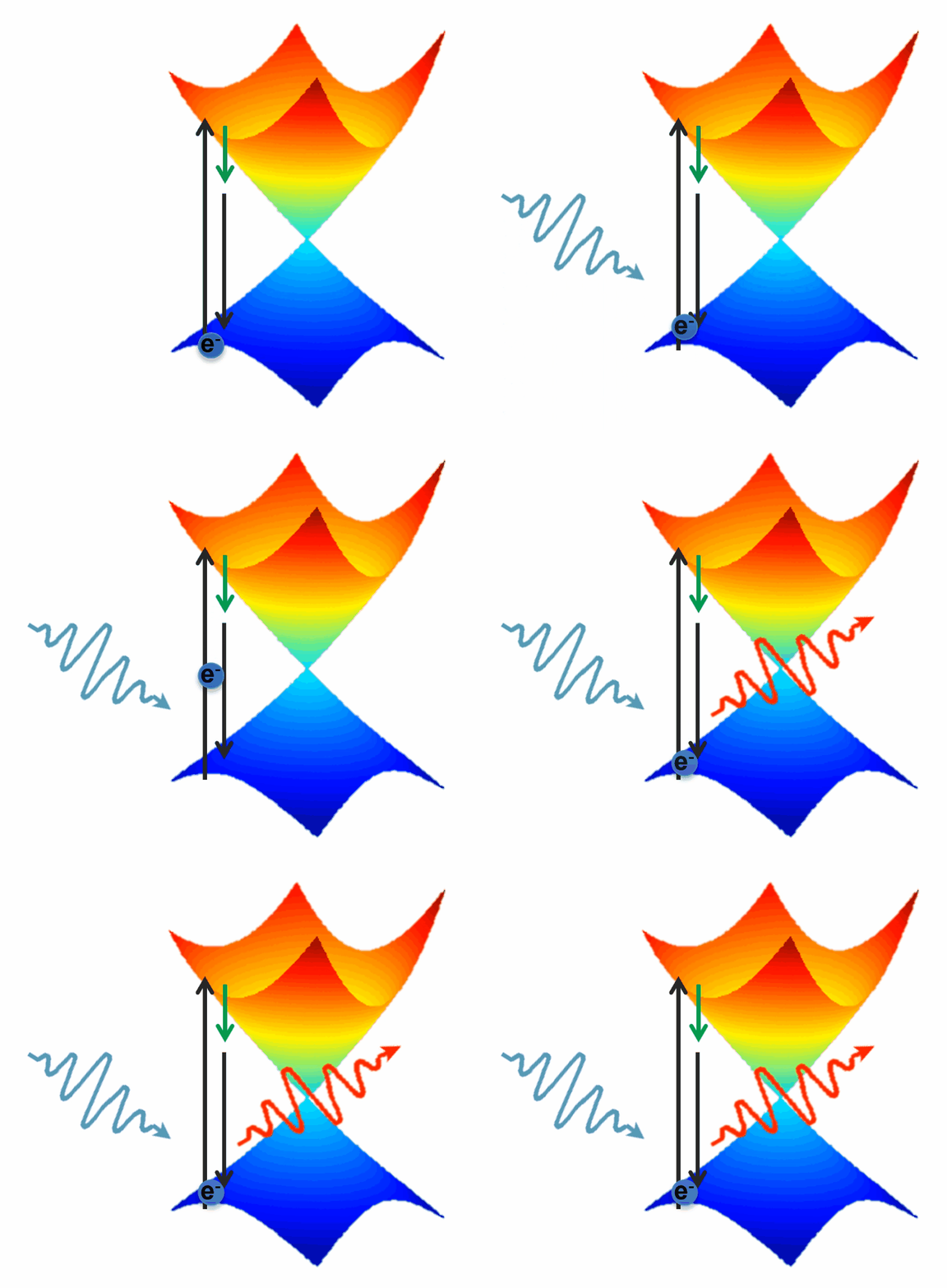
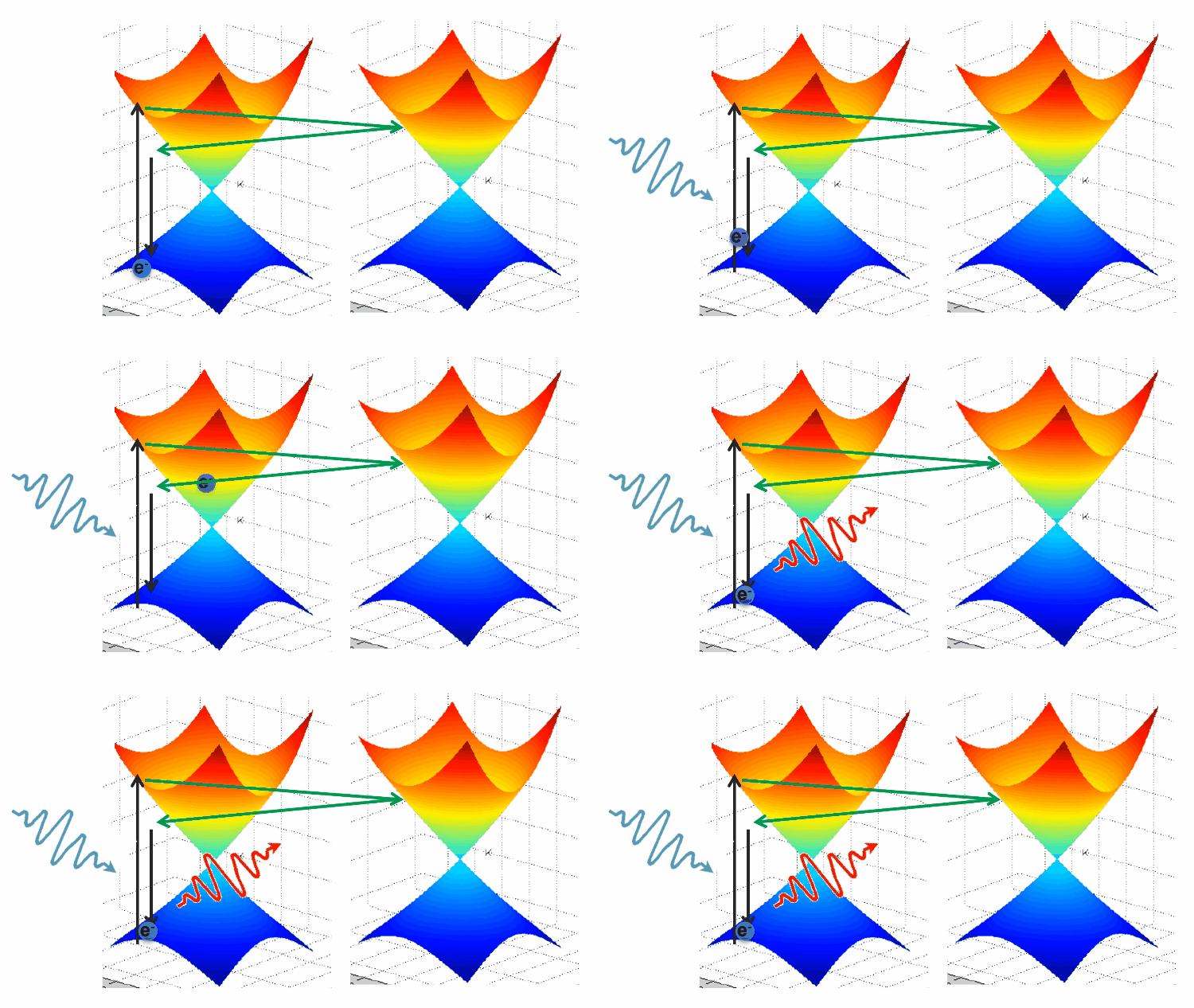 The Raman scattering process in single and double resonant case
A complete Raman scattering process comprise optical absorption, electron-phonon scattering and optical emission. Here, we consider three kinds of resonant Raman process, i.e. single-resonant, double-resonant and defect-induced double resonant Raman. The single-resonant Raman process involves only one phonon mode which belongs to the \(\Gamma\) point, while the double-resonant Raman involves two phonons which possess opposite momentum and in principle can be distributed over the whole Brillouin zone. The defect-induced double resonant Raman is a special case of double resonant Raman where the second electron-phonon scattering is replaced by an electron-defect elastic scattering with no energy transfer. A typical defect-induced double resonant Raman is the 2D Raman band in graphene.
With a Raman shift of \( \omega_{RS} \), the single resonant Raman intensity as a function of the incident laser energy \( E_L \) can be described as following expression:
\[ I\left(E_{L}\right) \propto \sum_{\mu} \left | \mathbf{e}_{S}^{\dagger} \cdot \stackrel{\leftrightarrow}{\mathbf{R}}\left(\mu,E_{L}\right) \cdot \mathbf{e}_{L} \right | ^{2} \times\delta \left( \hbar\omega_{RS} \pm \hbar\omega_{\mu} \right )\]
where \(\mathbf{e}_{L}\), \(\mathbf{e}_{S}\) represent the polarization directions of incident light and scattered light, respectively, \(\omega_\mu\) denote phonon frequencies corresponding to the phonon modes \(\mu\) at \(\Gamma\) point. The Dirac delta function ensures energy conservation throughout the Raman process. The + (-) sign corresponds the anti-stokes (stokes) process. The single resonant Raman tensor,\(\stackrel{\leftrightarrow}{\mathbf{R}}\), takes a third-order perturbation form of
\[\stackrel{\leftrightarrow}{\mathbf{R}}\left(\mu,E_{L}\right) = \sum_{\mathbf{k}} \sum_{i=f,n,n^{\prime}} \frac{ \mathbf{D}_{fn^{\prime}}\left(\mathbf{k}\right) \cdot g_{n^{\prime}n}^{\mu}\left(\mathbf{k}\right) \cdot \mathbf{D}_{ni}^{\dagger}\left(\mathbf{k}\right)}{\left ( E_{L}-E_{ni}-\mathrm{i}\gamma_{n} \right ) \left ( E_{L}-E_{n^{\prime}i} \pm \hbar\omega_{\mu}-\mathrm{i}\gamma_{n^{\prime}} \right )}\]
Here,
\(\mathbf{k}\) summation implies an integral over the first BZ and the sums over
\(i=f\) are over all eigenstates belonging to the valence bands, while
\(n\),
\(n^{\prime}\) to the conduction bands. The energy terms
\(E_{ni}\) \(\left(E_{n^{\prime}i}\right)\) are the vertical transition energy from the initial state
\(\left|i\right\rangle\) to the intermediate state
\(\left|n \right \rangle\) \(\left(\left|n^{\prime}\right \rangle\right)\) and
\(\gamma_{n}\) \(\left(\gamma_{n^{\prime}}\right)\) denotes the broadening factor of the resonance event, which is inversely proportional to the lifetime of the corresponding intermediate state.
\(\ \hat{\mathbf{D}}\) is the dipole vector operator, and the matrix elements of
\(\ \mathbf{D}_{ni}\) and
\(\ \mathbf{D}_{fn^{\prime}}\) describe the absorption and emission of photons in the Raman process respectively.
\( g_{n^{\prime}n}^{\mu}\) is electron-phonon coupling matrix elements, which discribe how an excited electron in
\(n\) state is scattered to an another excited state of
\(n^{\prime}\) by the
\(\mu\) phonon mode.
Similarly, the double resonant Raman intensity as a function of the incident laser energy \( E_L \) can be described as:
\[ I\left(E_{L}\right) \propto \sum_{\mathbf{q}} \sum_{\mu,\nu} \left | \mathbf{e}_{S}^{\dagger} \cdot \stackrel{\leftrightarrow}{\mathbf{R}}\left(\mathbf{q},\mu,\nu,E_{L}\right) \cdot \mathbf{e}_{L} \right | ^{2} \times\delta \left( \hbar\omega_{RS} \pm \hbar\omega_{\mu} \pm \hbar\omega_{\nu} \right ) \]
where \(\mathbf{q}\) are phonon wavevectors sampling the whole BZ homogeneously. The \(\mu\) and \(\nu\) are arbitrary two phonon modes at \(\mathbf{q}\) point sequently by which the excited electron is scattered to \(n^{\prime}\) and \(n^{\prime\prime}\) state. The double resonant Raman tensor takes a fourth-order perturbation form of
\[\stackrel{\leftrightarrow}{\mathbf{R}}\left(\mathbf{q},\mu,\nu,E_{L}\right) = \sum_{\mathbf{k}} \sum_{i=f,n,n^{\prime},n^{\prime\prime}} \frac{ \mathbf{D}_{fn^{\prime\prime}}\left(\mathbf{k}\right) \cdot g_{n^{\prime\prime}n^{\prime}}^{\nu_{-\mathbf{q}}}\left(\mathbf{k}+\mathbf{q}\right) \cdot g_{n^{\prime}n}^{\mu_{\mathbf{q}}}\left(\mathbf{k}\right) \cdot \mathbf{D}_{ni}^{\dagger}\left(\mathbf{k}\right)}{\left ( E_{L}-E_{ni}-\mathrm{i}\gamma_{n} \right ) \left ( E_{L}-E_{n^{\prime}i} \pm \hbar\omega_{\mu}-\mathrm{i}\gamma_{n^{\prime}} \right ) \left ( E_{L}-E_{n^{\prime\prime}i} \pm \hbar\omega_{\mu} \pm \hbar\omega_{\nu}-\mathrm{i}\gamma_{n^{\prime\prime}} \right )}\]
Inputs of Raman calculation
| prtRaman |
Type: LOGICAL |
Default: .true. |
| Description |
if .true., print Raman intensity |
| Raman_type |
Type: CHARACTER |
Default: 'double' |
| Description |
if 'single' then computes single-resonance Raman; 'double' computes double-resonance Raman;'defect' computes defect-induced double-resonance Raman |
| lhoph |
Type: LOGICAL |
Default: .false. |
| Description |
if .true., consider the hole-phonon coupling |
| reson_lim |
Type: LOGICAL |
Default: .true. |
| Description |
if .true., take a limitation on the energy level seperation in resonant transition |
| reson_thr |
Type: REAL |
Default: 1.d0 |
| Description |
if 'reson_lim' = .true., then set the threshold value of limitation |
| Elaser |
Type: REAL |
Default: 1.96d0 |
| Description |
the incident laser energy (eV) |
| Egamma |
Type: REAL |
Default: 1.d-1 |
| Description |
electronic energy broadening, relevant to the electron life (eV) |
| polar |
Type: CHARACTER |
Default: 'custom' |
| Description |
if 'custom', calculate the Raman in given polarization, if 'all', output all possible polarization |
| filraman |
Type: CHARACTER |
Default: 'qraman' |
| Description |
if polar = 'custom', the file name where the Raman intensity is stored |
| ei(3) |
Type: COMPLEX |
Default: (/ (1.d0,0.d0),(0.d0,0.d0),(0.d0,0.d0) /) |
| Description |
if polar = 'custom', incident light polarization |
| es(3) |
Type: COMPLEX |
Default: (/ (1.d0,0.d0),(0.d0,0.d0),(0.d0,0.d0) /) |
| Description |
if polar = 'custom', scattered light polarization |
| Cq |
Type: REAL |
Default: (/ 0.d0, 0.d0, 0.d0, 1.d0, 0.d0, 0.d0, 0.d0 /) |
| Description |
The coefficients of each power of q in formula of q-dependent defect-electron scattering |
| lBE |
Type: LOGICAL |
Default: .false. |
| Description |
if .true., consider the Bose-Einstein distribution of phonons |
| temphon |
Type: REAL |
Default: 3.d2 |
| Description |
if lBE = .true., the temperature at which phonons BE distribution is considered (K) |
| ltensor |
Type: LOGICAL |
Default: .false. |
| Description |
if .true., print Raman tensor |
| qtensor_start |
Type: INTEGER |
Default: 1 |
| Description |
if ltensor = .true., this indicates the first q of which the Raman tensor is printed |
| qtensor_end |
Type: INTEGER |
Default: 1 |
| Description |
if ltensor = .true., this indicates the last q of which the Raman tensor is printed |
| prtdipole |
Type: LOGICAL |
Default: .false. |
| Description |
if .true., print the interpolated dipole matrix elements |
- Parameters in raman_pp.in
| dir_raman |
Type: CHARACTER |
Default: '../qraman' |
| Description |
the directory where the Raman data files are stored in the previous run |
| Raman_type |
Type: CHARACTER |
Default: 'double' |
| Description |
keep the same set as in raman.in |
| lhoph |
Type: LOGICAL |
Default: .false. |
| Description |
keep the same set as in raman.in |
| lRay_sca |
Type: LOGICAL |
Default: .false. |
| Description |
if .true., consider the Rayleigh scattering. It is recomended to set .false. in order to undermine the strong Raman intensity in the vicinity of 0 cm-1 |
| Ray_thr |
Type: REAL |
Default: 5.d0 |
| Description |
if lRay_sca = .false., this set the radius threshold centered at 0 cm-1, within which the Raman intensity is undermined |
| Rs_min |
Type: REAL |
Default: -4.d3 |
| Description |
the minimum frequency in Raman shift (cm-1) |
| Rs_max |
Type: REAL |
Default: 4.d3 |
| Description |
the maximum frequency in Raman shift (cm-1) |
| Rs_inc |
Type: REAL |
Default: 1.d-1 |
| Description |
the frequency increment in Raman shift (cm-1) |
| Lgamma |
Type: REAL |
Default: 1.d1 |
| Description |
Lorentz function broadening, relevant to the FWHM of Raman peaks (cm-1) |
| lRaman_modes |
Type: LOGICAL |
Default: .false. |
| Description |
if .ture., perform Raman modes analysis. This, along with the following parameters, only work in (defect-induced) double resonant Raman cases. |
| nphonon_modes |
Type: INTEGER |
Default: 6 |
| Description |
how many pairs of phonon modes are demonstrated for the assignment of each Raman band |
| nRaman_modes |
Type: INTEGER |
Default: 1 |
| Description |
how many Raman modes are analyzed |
| Raman_modes(:) |
Type: REAL |
Default: 0.d0 |
| Description |
the Raman shifts of nRaman_modes Raman modes that are to be analyzed |